Core Aeration in Rugby, ND: What the Process Actually Involves and Why Late Summer Is the Right Window
If you are searching for core aeration Rugby, ND, you are asking about a mechanical soil treatment that makes a measurable difference in how North Dakota turf performs through the growing season and into dormancy. Our team at Outdoor FX, based in Minot, ND, serves Rugby and the surrounding region. Minot sits in a climate defined by hard winters, clay-heavy soils, and dramatic freeze-thaw cycles that compact the root zone year after year, and the same conditions extend across Pierce County into Rugby. Late summer into early fall is exactly when we schedule this work, and the timing is not arbitrary.
Core aeration is the process of mechanically removing small plugs of soil from your lawn to relieve compaction, improve root depth, and allow fertilizer, water, and oxygen to reach the root zone more effectively. In Rugby, ND, the best window for this service is late August through mid-September, when cool-season grasses are entering a natural recovery phase and can take full advantage of the open soil channels before winter sets in.
Key Takeaways
- Core aeration physically removes soil plugs to break up compaction, which is a persistent problem in the clay-heavy soils common across Pierce County.
- Late August through mid-September is the optimal window for core aeration Rugby, ND, because cool-season grasses recover fastest when soil temperatures are still warm but air temperatures have begun to drop.
- Aeration cores should be left on the surface to break down naturally, not raked up, as they reintroduce organic matter back into the lawn.
- Pairing aeration with overseeding dramatically improves seed-to-soil contact and germination rates compared to overseeding alone.
- A single aeration pass may not be sufficient for severely compacted turf; our team assesses the property before recommending the right approach.
What Core Aeration Actually Does to Your Soil
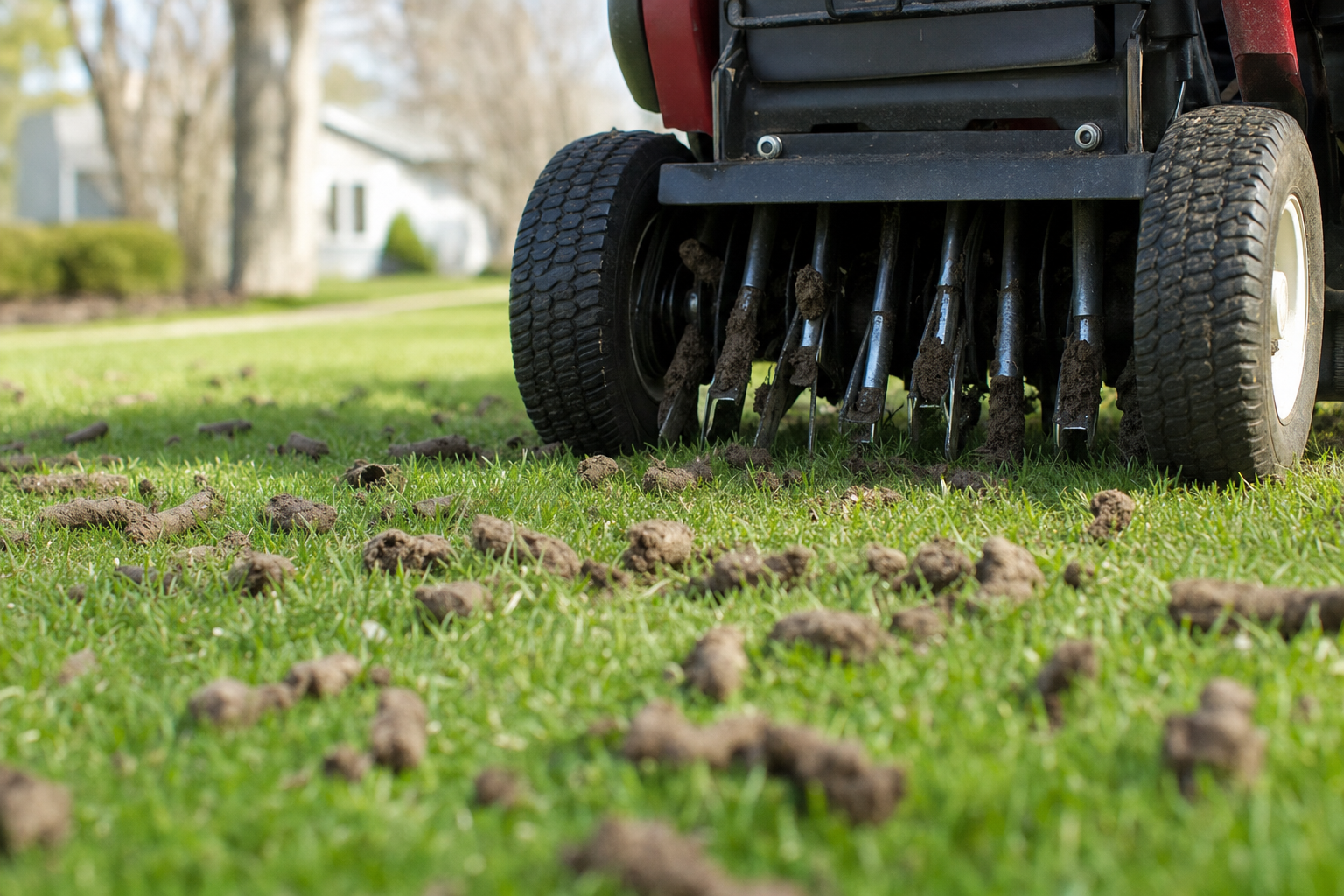
The term gets used loosely, so it helps to understand what is physically happening. A core aerator uses hollow tines, typically spaced a few inches apart, that punch into the ground and pull out cylindrical plugs of soil roughly two to three inches deep. Those plugs get deposited on the surface. What is left behind is a grid of open channels running down into the root zone.
In Rugby and across Pierce County, the soil profile tends to run heavy with clay. Clay compacts under pressure, and in a residential lawn that pressure comes from foot traffic, mowing equipment, and the repeated freeze-thaw cycles that North Dakota winters produce. Once the soil compacts, the pore spaces that normally hold air and allow water to drain close off. Roots hit a wall and spread laterally instead of driving deep. Fertilizer sits near the surface instead of reaching the root zone. Water either pools or runs off instead of absorbing.
Core aeration breaks that cycle. The open channels allow roots to push deeper, water to infiltrate more efficiently, and fertilizer to move where it can actually do something. This is also why aeration pairs so well with overseeding and fertilization programs. Seed dropped into an aerated lawn has direct soil contact in those channels, which is the single biggest factor in germination success.
Why Does the Timing of Core Aeration Rugby, ND Matter So Much?
Timing core aeration around the grass type and the local climate is not optional. It determines whether the treatment helps or stresses the lawn further. Rugby sits in a climate zone where cool-season grasses like Kentucky bluegrass and fescue dominate. These grasses grow aggressively in spring and fall, slow down in the heat of July and early August, and then push another growth flush as temperatures moderate in late summer.
That late-summer recovery window, roughly late August into mid-September here, is the target. Soil temperatures are still warm enough to support root activity, which means the grass can fill in the aeration holes quickly and the root system can capitalize on the newly opened channels before the ground freezes. Aerating too early in the summer heat stresses an already-struggling lawn. Aerating too late in fall leaves the turf little time to recover before dormancy.
We also factor in soil moisture at the time of service. Aerating bone-dry, hard soil reduces tine penetration depth and limits the effectiveness of the treatment. If conditions are very dry heading into the service date, running your irrigation system for a day or two beforehand softens the soil and allows the tines to pull deeper, cleaner plugs.
What to Expect During the Service Visit
Before we run the aerator, our team walks the property. We are looking at the overall turf density, any areas of visible compaction or standing water history, and the condition of the soil surface. Severely compacted areas may need a double pass, where we run the aerator in two directions to increase the number of channels per square foot.
The aerator itself is a walk-behind or ride-on machine depending on the property size. It covers the lawn in overlapping passes, and the hollow tines pull plugs continuously as it moves. The plugs left on the surface look messy for a week or two, but they should stay there. As they dry out and break down with rain and mowing, they reintroduce organic matter back into the surface layer. Raking them up defeats part of the purpose.
After aeration, the lawn is in an ideal state for overseeding. The open channels provide the seed-to-soil contact that surface overseeding alone cannot reliably achieve. If the turf has thin or bare patches, this is the time to address them. Our landscape maintenance programs can fold in overseeding and post-aeration fertilization as part of a coordinated fall turf plan.
For properties where compaction is connected to a drainage problem, aeration alone will not solve the underlying issue. In those cases, we look at whether grading or a drainage solution is needed alongside the turf work. Our post on French drains covers how that side of the problem gets addressed when water movement is the root cause.
How Do You Know If Your Rugby Lawn Actually Needs Core Aeration?
There are a few reliable indicators. If water puddles in areas that should drain after a normal rain, compaction is likely limiting infiltration. If your lawn feels spongy or has a thick thatch layer, more than about half an inch of accumulated organic debris between the soil and the grass blades, aeration helps break through that barrier. If the turf has thinned out despite regular fertilization and watering, restricted root depth from compaction is often the reason the inputs are not converting into healthy growth.
You can also do a simple screwdriver test. Push a standard screwdriver into the soil with hand pressure. If it stops within two inches, the soil is compacted enough that aeration will make a measurable difference. If it slides in four to six inches without much resistance, the soil structure is in reasonable shape.
For properties that have never been aerated, or that have gone several years between treatments, the difference after a single professional aeration pass is usually visible within a few weeks as the turf fills in and the color deepens. Scheduling core aeration Rugby, ND starts with a custom estimate based on your property size and condition. You can reach our team here to get that process started before the late-summer window closes.
Frequently Asked Questions
How often should Rugby, ND homeowners schedule core aeration?
For most lawns in the Rugby area, once per year in late summer or early fall is the standard recommendation. Lawns with heavy clay soil, high foot traffic, or a history of compaction issues may benefit from aeration twice a year, once in fall and once in early spring before the peak growing season. Our team can assess your specific turf conditions and advise on frequency.
Should I water my lawn before core aeration Rugby, ND?
Yes, lightly irrigating one to two days before your scheduled service helps soften the soil and allows the tines to penetrate deeper. The goal is moist but not saturated soil. Waterlogged ground can cause the plugs to smear rather than pull cleanly, which reduces the effectiveness of the treatment.
Can core aeration help with lawn disease problems?
Compacted soil with poor drainage creates the consistently moist, low-airflow conditions that many fungal lawn diseases thrive in. Aeration improves both drainage and air circulation at the soil surface, which can reduce disease pressure over time. That said, if active disease is present, aeration alone is not a treatment. Our lawn disease treatment services address active infections directly, and aeration fits into the longer-term prevention strategy.
Is core aeration the same as dethatching?
No, they address different problems. Dethatching mechanically removes the layer of accumulated organic debris between the soil and the grass blades. Core aeration addresses compaction within the soil itself. Both can be relevant for the same lawn, and in some cases we recommend doing them in sequence, but they are separate processes with separate equipment and separate goals.