Erosion Control in Williston, ND: A Real Plan
Drive out toward the Missouri River breaks west of Williston and you’ll see what uncontrolled runoff actually does to bare ground out here. The gumbo clay that dominates so much of this basin doesn’t absorb water, it sheds it, and when that water has nowhere to go it carves channels fast. Our team at Outdoor FX works out of Minot, ND, where the same freeze-thaw cycles and clay-heavy soils that punish northwestern North Dakota every spring give us a deep read on what unprotected ground goes through over a winter. We’ve spent years watching the same pattern repeat itself across the oil patch corridor: a contractor grades a lot, leaves bare soil exposed, and by the time the property owner is ready to finish the project, the slope has already started moving. Before we get into the specifics of erosion control Williston, ND properties need right now, it helps to understand why this particular corner of North Dakota is so hard on unprotected ground.
Erosion control in Williston, ND means stabilizing bare or disturbed soil using a combination of grading corrections, erosion blankets, hydroseeding, French drains, retaining walls, and drainage infrastructure to redirect water before it removes soil from slopes, yards, or construction sites. The right solution depends on soil type, slope grade, water volume, and how the land has been disturbed. A custom estimate is the only accurate way to budget a project.
Key Takeaways
- Williston’s gumbo clay soil sheds water rather than absorbing it, making slopes and graded areas especially vulnerable to fast-moving erosion.
- Late summer is the right time to address erosion before fall rains and the freeze-thaw cycles of a North Dakota winter accelerate damage.
- Effective erosion control typically combines multiple methods, including grading, hydroseeding, drainage redirection, and structural solutions like retaining walls.
- Oil patch construction activity across Williams County has left a significant number of properties with disturbed, compacted, or poorly graded soil that needs professional stabilization.
- Outdoor FX serves Williston and the surrounding region from its base in Minot, ND, with full-service landscaping and hardscaping support available alongside erosion work.
What Williston’s Soil and Oil Patch History Actually Do to Your Property
Williams County has seen more ground disturbance in the last fifteen years than most regions see in a generation. The Bakken boom brought in heavy equipment that compacted subsoil, stripped topsoil, and left thousands of acres in various states of incomplete grading. Even residential lots in subdivisions along Highway 2 and around the Airport Road corridor show the effects: shallow topsoil, compacted clay underneath, and drainage patterns that were never properly engineered for the finished grade.
That clay subsoil is the real problem. When it’s wet, it becomes slick and mobile. When it dries, it cracks and creates channels for the next rain event to exploit. We’ve seen slopes near the Missouri River breaks lose several inches of topsoil in a single hard summer storm. August storms in this part of North Dakota can drop an inch or more of rain in under an hour, and on an unprotected slope, that kind of intensity moves a lot of material. Waiting until spring to address it means letting a freeze-thaw winter work on already-weakened soil, which almost always makes the problem significantly worse.
Effective erosion control starts with understanding the specific failure point on a given property. Is water sheeting across a slope? Is it concentrating in a swale and cutting a channel? Is a foundation or retaining structure being undercut? Each of those problems calls for a different primary solution, and most real-world erosion jobs require more than one approach working together.
How Does Erosion Control Williston, ND Actually Work on a Typical Property?
The process starts with a site read. Our team walks the property and traces where water enters, where it moves, and where it exits or pools. On most Williston-area properties, we’re looking at a combination of slope grade, soil condition, existing vegetation cover, and proximity to structures or hardscaping.
From there, solutions get layered. Grading corrections redirect water away from vulnerable areas before it builds speed. Drainage and grading work is often the foundation of any serious erosion project, because no surface treatment holds long-term if the underlying water movement isn’t addressed. French drains intercept subsurface water that would otherwise saturate and destabilize a slope. You can read more about how those systems work in our post on French drains in Minot, ND, and the principles apply directly to Williston terrain.
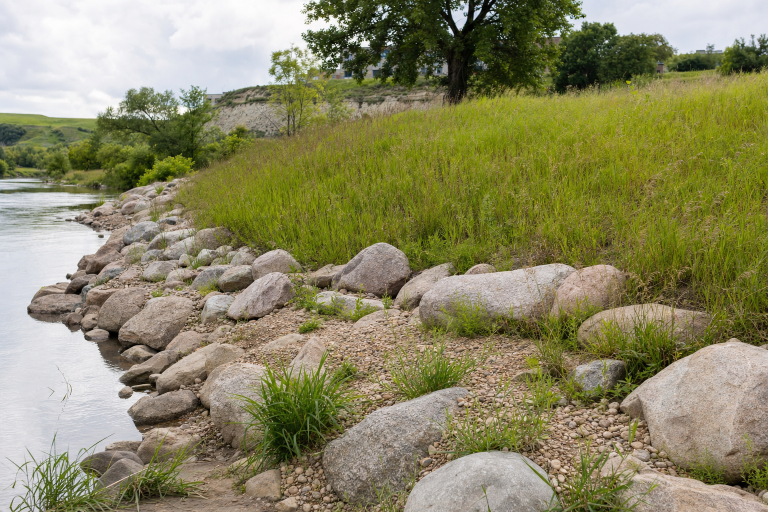
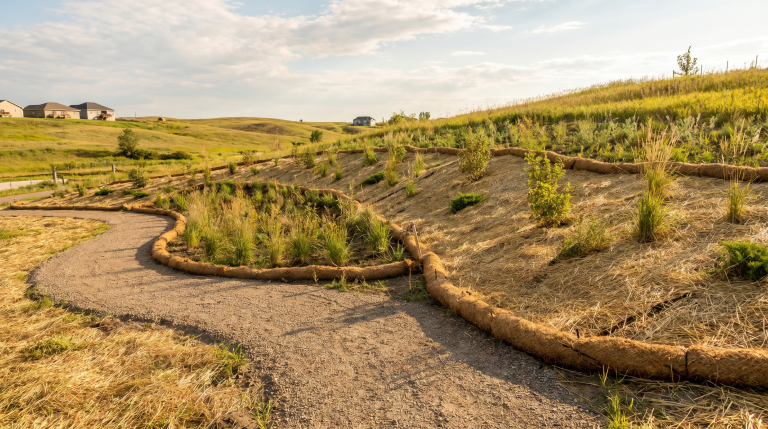
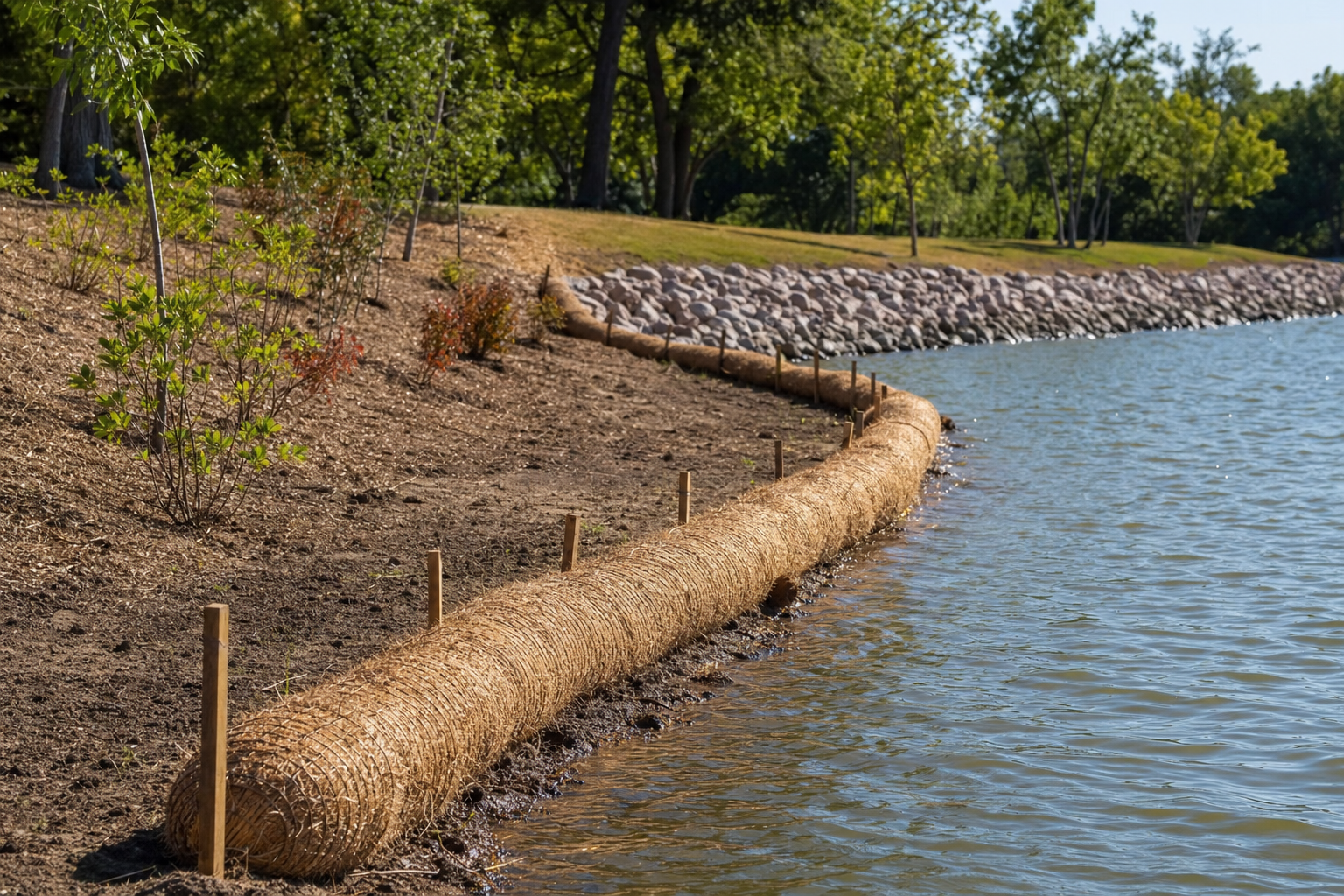
Once drainage is corrected, surface stabilization takes over. Hydroseeding is one of the most effective tools we use on larger bare slopes because it establishes a root matrix quickly and the tackifier in the slurry holds soil in place while germination happens. Erosion blankets serve a similar function on steeper grades where seed alone needs additional protection. The North Dakota Department of Transportation’s erosion and sediment control guidance is a useful reference for understanding how those measures are matched to site conditions. On slopes where water volume or grade makes vegetation-only solutions insufficient, retaining walls built from natural stone, block, or timber provide structural reinforcement that vegetation can’t replicate. Our hardscaping team handles that side of the work, and integrating walls with proper drainage behind them is something we plan from the start rather than adding as an afterthought.
Neighborhoods and Roads Where We See the Most Erosion Pressure
The properties that call us most often for erosion control Williston, ND share a few common traits. Lots near the Missouri River bluffs deal with dramatic grade changes and soils that are naturally prone to slumping. Subdivisions that were developed quickly during the boom years, particularly those off Airport Road and in the northeast quadrants of the city, often have drainage infrastructure that was sized for the original site plan rather than the finished density of the neighborhood. That mismatch shows up as standing water, saturated berms, and erosion channels that weren’t there when the lots were first sold.
We also work regularly with properties in the Watford City corridor, where similar oil patch grading history creates comparable challenges. If you’re curious how that work looks in practice, our post on landscaping services in Watford City covers the broader context well.
Commercial and industrial properties along the Highway 85 corridor present a different set of challenges, usually involving large disturbed areas with minimal topsoil and compacted subgrade that makes establishing any vegetation cover difficult without soil amendment and proper hydroseeding protocols. For projects with active construction disturbance, the EPA’s stormwater program overview offers helpful context on protecting nearby waterways from runoff.
Why August Is the Right Time to Act on Erosion Control in Williston, ND
Late summer is genuinely the best window for erosion control work across northwestern North Dakota. Hydroseeding done in August gives new root systems six to eight weeks to establish before the ground freezes. Grading corrections made now allow the soil to settle before freeze-thaw cycles begin working on it. Retaining walls and drainage structures installed before October have time to be properly backfilled and compacted before winter loads arrive.
Waiting until spring means surviving another North Dakota winter with an unprotected slope. Freeze-thaw action is one of the most destructive forces on bare soil, and a slope that looks manageable in October can lose significant material by April. The landscape maintenance and site repair work that follows a bad winter costs more and takes longer than the prevention would have.
If your property has bare slopes, compromised drainage, or grading that was never finished correctly, reach out to our team through the Outdoor FX contact page and we’ll put eyes on it before the fall rains make the decision for you.
Frequently Asked Questions
What makes Williston’s soil particularly prone to erosion?
The gumbo clay that underlies most of Williams County is dense and largely non-absorptive. When rain hits it, water runs off the surface rather than soaking in, which concentrates flow and creates erosion channels quickly. Decades of agricultural tillage and more recent oil patch construction have also stripped protective topsoil from large areas, leaving that clay exposed and vulnerable. Once erosion channels start forming in this material, they deepen fast.
Can I just seed bare areas myself and skip professional erosion control?
Seeding alone rarely holds on any slope with meaningful grade in this region. Without correcting the underlying drainage pattern, water will continue to concentrate in the same paths and wash seed out before it establishes. Professional erosion control addresses the cause of the movement, not just the surface symptom. On steeper slopes or properties with significant water volume, structural solutions like retaining walls or French drains are often necessary alongside any seeding work.
How long does it take for hydroseeding to stabilize a slope?
In Williston’s climate, germination typically begins within ten to fourteen days of a late-summer hydroseeding application, assuming adequate moisture. Root systems strong enough to meaningfully resist surface erosion develop over the following four to six weeks. That timeline is exactly why August applications are preferable, as they allow establishment before freeze-up. Our team monitors conditions and can advise on irrigation support through our irrigation services if natural rainfall is insufficient during the establishment period.
Does Outdoor FX handle both residential and commercial erosion control Williston, ND properties need?
Yes. We work on residential lots, acreages, commercial properties, and industrial sites across the Williston region. The scale and methods differ depending on the size of the disturbed area and the type of water management needed, but our approach is the same: assess the specific failure point, correct the drainage, and stabilize the surface. Pricing is always quote-based because no two properties present the same combination of grade, soil condition, and water volume.